Why don’t we want these pest species on pest free islands? We’ll tell you why!
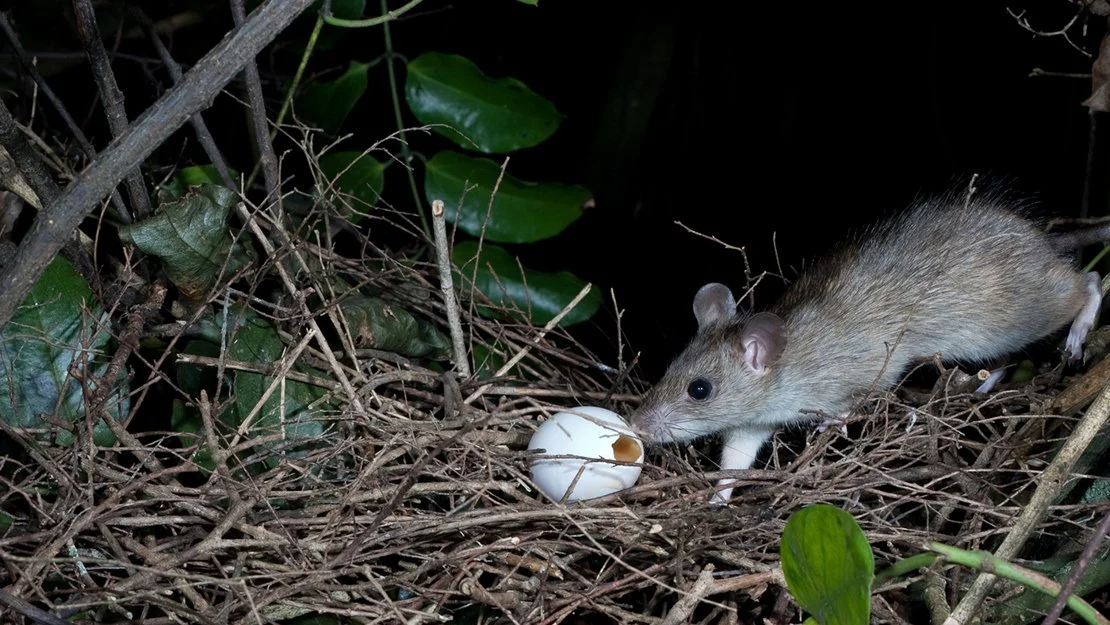
Rats and mice
Omnivores, feasting across food groups, including seeds, flowers, invertebrates, reptiles, amphibians, and young birds. They compete with native birds for nests and burrows and with many species for food. Ship rats (Rattus rattus) are good climbers to invade birds’ nests; Norway rats (Rattus norvegicus) are strong swimmers and kill burrow-nesting adult seabirds and their eggs and chicks, and kiore (Rattus exulans) kill land snails or wētā. Good pest control around wharves and storage areas can help reduce their numbers and keep them off vessels.
Plague skinks
Plague skinks (Lampropholis delicata) are cheeky Australian invaders and compete with our native lizards for food and habitat. The prolific egg layers reproduce rapidly to create high population densities and prey on a wide variety of invertebrates. Plague skinks’ scales have a distinctive iridescent rainbow sheen, seen in bright light. They also have one large scale on top of their head, whereas native skinks have two smaller scales.
Mustelids
Mustelids (stoats - Mustela erminea; ferrets - M. furo; weasels - M. nivalis) are some of the most devastating predators of our native species, preying on our ground-nesting and cavity-nesting birds, forest birds such as kiwi, amphibians, reptiles and invertebrates. Their ability to climb, travel long distances – with stoats able to swim up to 3km - adds to their risk. Stoats are 34-40cm long with reddish-brown fur on their back, a white or cream-coloured underbelly, and a long tail, with a distinctive bushy black tip.
Argentine ants
Argentine ants (Linepithema humile) are one of the top 100 invasives species in the world. They are aggressive and form super colonies, prey on invertebrates, kill poultry hatchlings, rob beehives, steal food from our native birds and interfere with pest plant biocontrol. They also have a reputation as a lifestyle pest, invading gardens and buildings and once introduced, are extremely difficult to eradicate. These tiny threats brown in colour and range from 2-3mm to 12mm long.
MORE INFORMATION
Department of Conservation - visiting pest free islands
Info about pests species - www.tiakitamakimakaurau.nz
Protecting the Hauraki Gulf islands - www.ourauckland.nz/haurakigulf
