
A clearer way to measure hull fouling
A new video explains how the Level of Fouling Scale helps biosecurity teams assess fouling on boats and reduce the risk of marine pests spreading around New Zealand.
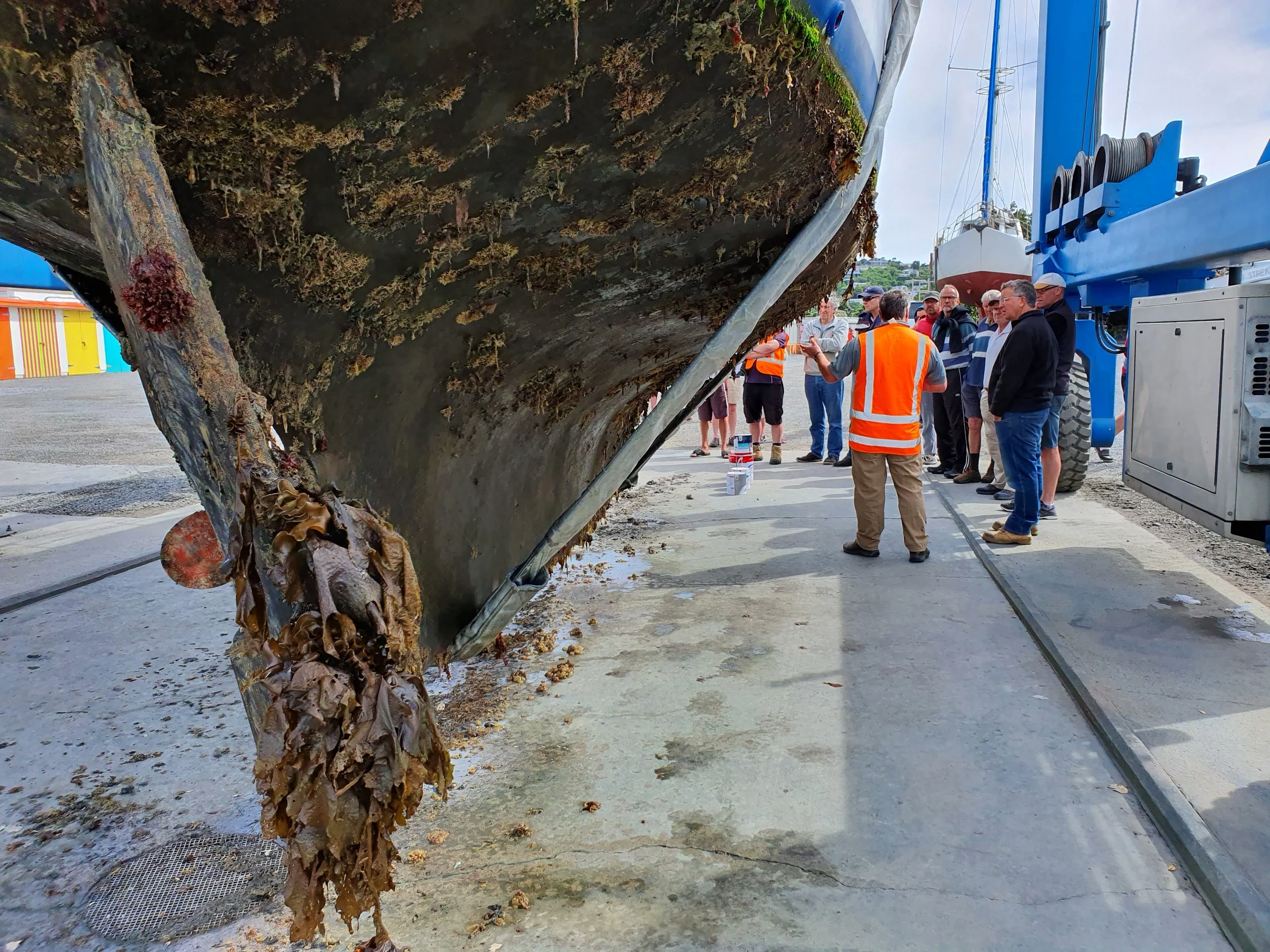
Biofouling on a boat in the Marlborough Sounds - Photo / Top of the South Marine Biosecurity Partnership
Fouling is growth that builds up on a boat’s underwater surfaces while it is in the water. It can include invasive species such as Mediterranean fanworm, clubbed tunicate and wakame. When a fouled boat moves to another harbour or region, those organisms may travel with it, get established and cause havoc.
The Level of Fouling Scale gives divers a quick, consistent way to assess that risk. Following a visual inspection of the hull and niche areas, a vessel is assigned a score from 0 to 5. The score reflects the proportion of a visible surface that is covered by biofouling.
Regional councils can use the result to decide whether a boat needs follow-up action. Several councils already use the Scale in hull surveillance, with results able to be recorded in the Marine Vessel Portal.
Liam Falconer of Marlborough District Council explains:
“We have a large number of recreational vessels that visit the region, particularly over the summer period. A lot of those vessels come from high-risk ports or high-risk areas, which really increases the risk and the impact to our region.
“The real risk to our region is to our aquaculture industry and our marine biodiversity.
“At the moment the biggest threat to the region is Mediterranean fanworm, although we currently don’t have any established populations, but we have had 80 incursions since 2014. So the risk remains: they continue to arrive. So it’s really about [managing] hull fouling levels.”
“We’ve been using the Scale since 2013 when we had our first incursion,” says Andy Wills of Bay of Plenty Regional Council. “Since then we’ve actually done over 12,000 boat hull inspections here in the Bay of Plenty.”
Hollie Kereopa of Patuharakeke Te Iwi Trust Board in the Far North says:
“Some of our species are in massive decline. So our overall goal is to restore the life force of these tāonga species. From a kaitiakitanga perspective, hull surveillance is the first line of defence when undertaking biosecurity mahi. Instead of us just going out and inspecting a boat and saying what we think from our perspective might be really high biofouling, now we’re able to quantify and measure that biofouling.”
Developed and refined over more than two decades, the Level of Foul scale helps organisations assess vessels consistently. Consistency is increasingly important as New Zealand strengthens its coordinated approach to marine biosecurity.
Watch the new four-and-a-half-minute video, produced by Cawthron Institute and Biosecurity New Zealand, to see how the Level of Fouling Scale is helping protect our marine environment, aquaculture and boating waters.